Skip to content
Order

The science

Antisense-based gene silencing

The science behind AUM's revolutionary RNA silencing platform

The platform

The AUMsilence platform

AUM BioTech's advanced antisense technology harnesses the power of AI-optimized oligonucleotides to achieve gene silencing at the RNA level

Innovative chemistry and molecular design

The AUMsilence platform represents a leap forward in RNA silencing technology. ASOs are designed as short (18-22 nucleotide) sequences that are complementary to the target RNA. They feature a gapmer architecture: a central DNA-like "gap" region flanked by modified RNA analogs that increase binding affinity and protect the oligo from degradation.

The central region, once bound to the target RNA, creates an RNA:DNA duplex that is recognized by RNase H1, an endogenous enzyme present in the nucleus and cytoplasm. RNase H1 cleaves the RNA strand of the duplex, fragmenting the target RNA and preventing its translation into protein. The ASO itself is not degraded in this process and can dissociate and bind additional RNA molecules, acting in a catalytic fashion.

  • Cytoplasmic and nuclear RNA: Acts on messenger RNA in the cytoplasm and on precursor and non-coding RNA in the nucleus.
  • Self-delivery: Taken up by endocytosis, with no transfection reagent, no carrier and no vector.
  • Stability: Chemical modifications protect the oligonucleotide from nuclease degradation.
  • Potency: One oligonucleotide acts catalytically: RNase H1 cuts the target and the oligonucleotide moves on to the next copy.
  • Specificity: Silencing follows Watson-Crick pairing to the target sequence, with no RISC involvement.
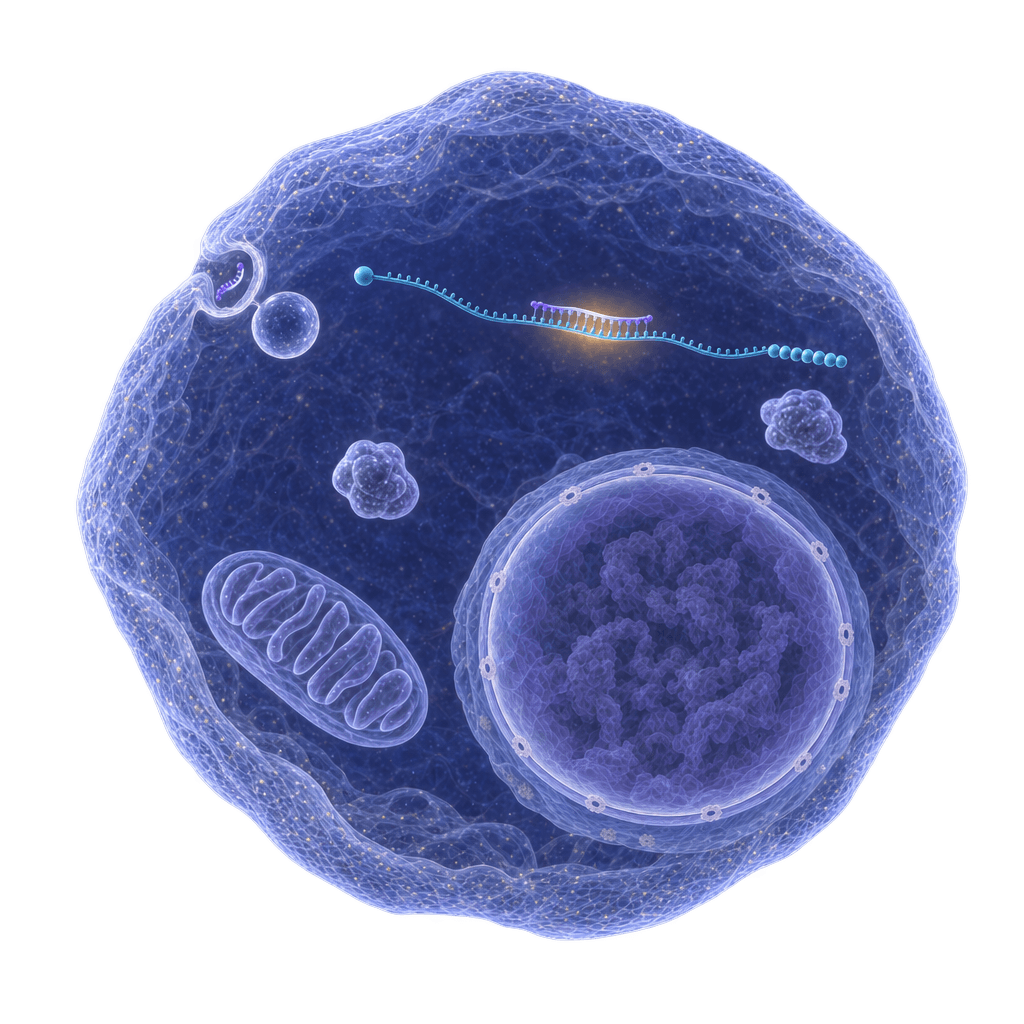
What reaches the inside of a cell: the self-delivering AUMsilence sdASO is taken up by endocytosis, a siRNA duplex and a CRISPR complex are not, and inside the cell RNase H1 cleaves the paired target RNA in the cytoplasm and in the nucleusOutside the cell, three molecules, the larger ones drawn larger. The self-delivering AUMsilence sdASO, a single short gapmer drawn as beads on a ribbon with its two wings filled and its central gap open, follows a solid route to a pit in the cell membrane and is taken up by endocytosis, with no transfection reagent. A siRNA duplex, two strands and visibly larger, and a CRISPR complex, a Cas protein with its guide RNA and larger again, follow dashed routes that stop outside the membrane at a no-entry mark: neither is taken up that way. Inside the cell, the oligonucleotide sits in an endosome beside the pit, then reaches the cytoplasm, where it is paired with a messenger RNA, and the nucleus, where it is paired with a nuclear RNA; on each pair RNase H1 sits on the duplex and the target RNA is cleaved, the oligonucleotide staying whole. The cell is a rendered picture: a whole cell whose membrane cups a single strand into a pit at its upper left, a vesicle beside it, a messenger RNA carrying a paired strand under a warm glow, a nucleus at the lower right, a mitochondrion and two small organelles.OUTSIDE THE CELLINSIDE THE CELLAUMsilence sdASOtaken up by endocytosissiRNA duplextwo RNA strandsCRISPR complexa Cas protein with its guide RNAEndosomeCytoplasmRNase H1CleavageNucleusRNase H1 cleavagetaken up by endocytosisnot taken up this way: needs a reagent or a vector
Our AUMsilence platform uses chemical modifications that enable self-delivery.

Target selection by machine learning

At the core of the AUMsilence platform is AUM BioTech's innovative AI-driven approach that optimizes oligonucleotide design. This AI analyzes target RNA sequences to identify the most accessible regions, predicts secondary structures, and selects optimal binding sites for maximum efficacy and specificity.

AUM BioTech's AI algorithms incorporate data from thousands of ASO designs.

Factors considered

  • RNA structural accessibility and folding patterns
  • Binding energy and thermodynamic stability
  • Potential off-target interactions across the transcriptome
  • Chemical modification patterns for RNase H1 recruitment
  • Sequence properties that enhance cellular uptake

This AI-driven approach ensures that each AUM ASO is customized to its specific target, resulting in 70-95% knockdown across diverse genes and experimental systems.

FigureWhere a design starts: the transcript, and the four stages
Reading the transcript.Still reading. A first read of a transcript can take a while; this page waits up to 20 seconds for it, and its scripts then bring in the figure, or a line saying what did not arrive.
  1. Stage 1: Reads the transcript. Every exon of the target transcript, as the reference annotation places it.
  2. Stage 2: Scores every candidate window. Each window along the transcript is scored for predicted activity and for specificity across the transcriptome.
  3. Stage 3: Learns from the published record. The scores draw on the published antisense literature and on how oligonucleotides interact with cellular proteins.
  4. Stage 4: Builds them with its chemistry. Several sequences are designed against different regions of the same transcript, and the strongest knockdown is found by testing more than one, which is why ordering more than one sequence per target is recommended.
The exons of a real transcript are drawn here from the live record once the read arrives, with the accession, the assembly, the source's release and the day it was read; the candidate windows, the chosen windows and the oligonucleotides are a schematic of the method, and no score is drawn.

Two categories, three steps

Product categories

AUM BioTech offers two primary categories of ASO products to meet diverse research needs:

Self-delivering ASOs (sdASO)

AUM BioTech's AUMsilence sdASO self-delivering antisense oligonucleotides (sdASO) can be used to achieve potent knockdown of various RNA modalities. These products include:

  • AUMsilence sdASOFor mRNA knockdown
  • AUMantagomir sdASOFor miRNA inhibition
  • AUMlnc sdASOFor lncRNA knockdown
  • AUMsilence V+ sdASOFor viral RNA knockdown

The key advantage of sdASO products is their ability to enter cells without any transfection reagents. Simply add sdASO to the cell culture or inject them in vivo, and they are taken up by endocytosis, without the need of any transfection reagent, formulation, or delivery vehicle.
Transfection-optimized ASOs (toASO)

For researchers working with standard cell lines or conducting high-throughput screens where cost-efficiency is important:

  • AUMsilence toASOBudget-friendly ASOs optimized for transfection

AUMsilence toASO maintains the core advantages of AUM BioTech's AUMsilence platform (high potency, specificity, and stability) while being specifically designed for standard transfection methods. This makes it perfect for routine gene silencing applications where transfection is the preferred delivery method and budget is a consideration.

  1. The mechanism frame for step 1: endocytosis

    Step 1: ASO entry

    For sdASO products, the modified antisense oligonucleotide enters the cell without transfection reagents, thanks to its optimized chemical structure. AUMsilence toASO products are delivered using standard transfection methods.

  2. The mechanism frame for step 2: binding and cleavage in the cytoplasm

    Step 2: Target binding

    Once inside the cell, the ASO binds to its target RNA (mRNA, microRNA, or lncRNA) with high affinity and specificity, forming an RNA:DNA hybrid duplex. AUM BioTech's AI-optimized design ensures binding to the most accessible regions.

  3. The mechanism frame for step 3: the nucleus

    Step 3: RNase H1 cleavage

    The RNA:DNA hybrid is recognized by cellular RNase H1, which cleaves the RNA strand, degrading the target RNA while leaving the ASO intact to target additional RNA molecules. This catalytic process amplifies the silencing effect.

What the cleavage produces

From mRNA to protein silencing

By cleaving messenger RNA transcripts, AUM's antisense technology effectively reduces or abolishes the production of the target protein. Target mRNA levels drop first and protein levels follow, at a pace set by the protein's own half-life. The mode of action follows the sequence: cleavage needs the oligonucleotide and the transcript to pair, and a transcript that pairs in part can be bound as well, which is why every candidate sequence is scored for homology across the transcriptome before it is chosen.

Nuclear and cytoplasmic action

A key advantage of antisense mechanism is that it works in both the nucleus and cytoplasm. siRNAs and shRNAs primarily act in the cytoplasm on processed mRNA, whereas AUM's antisense oligonucleotides can also bind precursor mRNAs or lncRNAs in the nucleus. This broad cellular reach allows silencing of RNAs at multiple stages (from pre-spliced nuclear RNA to mature cytoplasmic mRNA) and is particularly useful for targeting nuclear-retained RNAs.

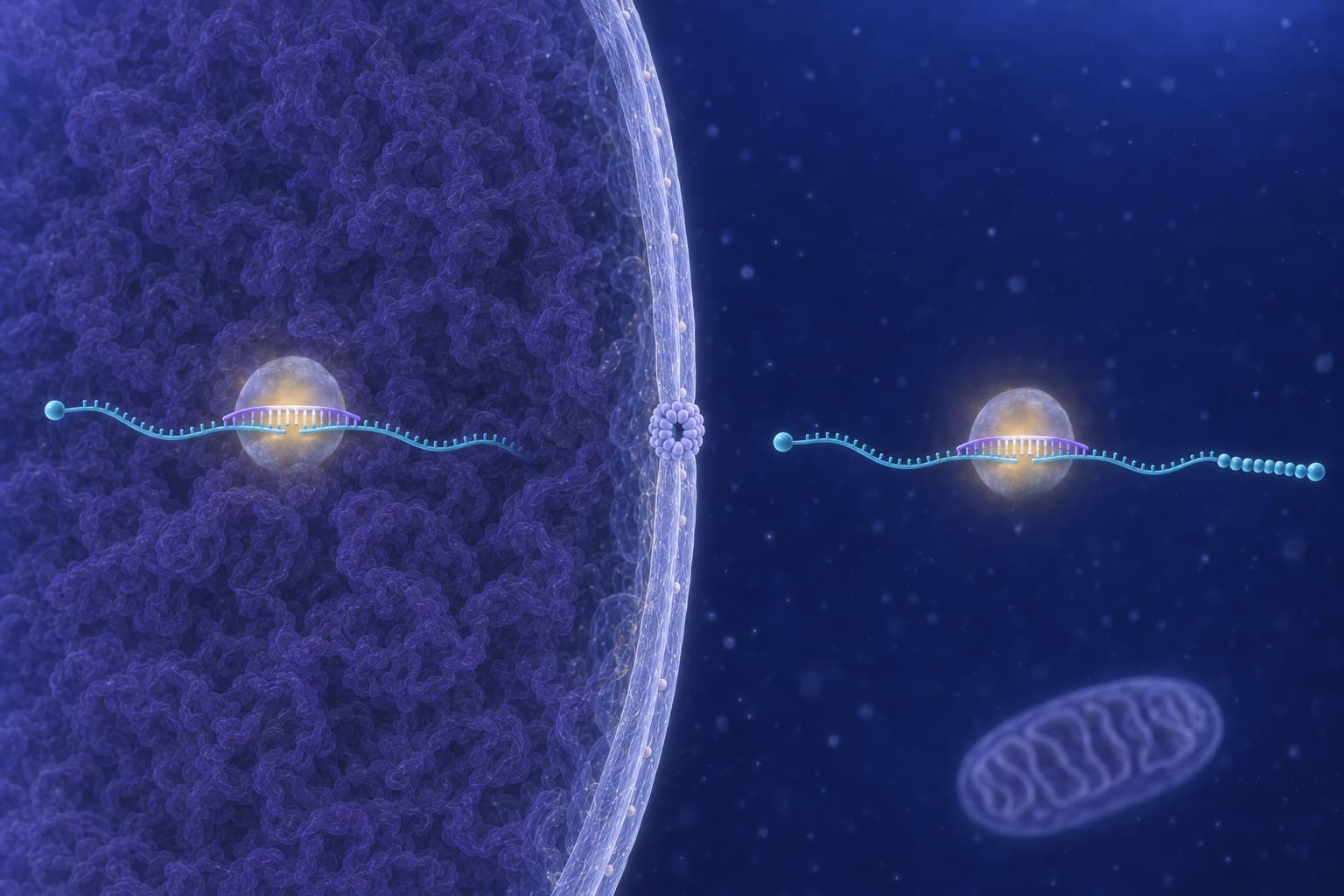
A cell's nucleus, packed with violet chromatin, fills the left of the frame and its cytoplasm the right, parted by the nuclear envelope with a single pore complex; in each compartment a blue-teal RNA, capped at one end, carries an antisense gapmer, a strand with a pale central gap between its two violet wings, paired along one stretch under a warm glow, where a translucent RNase H1 sits on the gap and the RNA is cut beneath it: a capped, tailless precursor messenger RNA winding among the chromatin on the left, and a mature messenger RNA with a beaded tail on the right, near a mitochondrion at the lower right.
The paired message cut in the nucleus and in the cytoplasm

Against the alternatives

Comparison with siRNA, shRNA, and CRISPR

Understanding how AUM's antisense technology compares to other gene-silencing approaches

Comparison with siRNA, shRNA, and CRISPR
FeatureSelf-delivering ASO (sdASO)siRNA (RNAi)shRNACRISPR/Cas9
Delivery methodSelf-delivering, no transfection neededRequires transfection reagents or lipid carriersRequires viral vectors or plasmid transfectionComplex delivery systems (viral vectors, electroporation)
MechanismRNase H1-mediated RNA cleavageRISC-mediated RNA cleavageProcessed to siRNA, then RISC-mediatedDNA modification/genome editing
Cell type rangeWorks in cell lines and hard-to-transfect primary cellsChallenging in primary and hard-to-transfect cellsLimited by viral transduction efficiencyVariable efficiency across cell types
Off-target effectsMinimal, sequence-based onlyCommon via seed region matchingSimilar to siRNA, plus insertion effectsPotential unintended genome modifications
Duration of effectTransient and dose-dependent (days to weeks)Transient (days)Long-term with stable integrationPermanent genetic modification
Speed to resultsFastFastSlow (weeks for stable lines)Slow (weeks for clonal selection)
Nuclear RNA targetsYes, works in nucleusLimited, primarily cytoplasmicLimited, primarily cytoplasmicIndirectly, by modifying DNA
Workflow complexitySimple (add to medium)Moderate (transfection optimization)Complex (cloning, viral packaging)Most complex (design, cloning, selection)

sdASO vs. siRNA (RNAi)

Small interfering RNAs (siRNAs) rely on the RISC complex to bind and cleave target mRNA. Unlike siRNAs, which typically require cationic lipid transfection, sdASO products are self-delivering and have shown efficient uptake even in primary immune cells and neurons without any carrier.

siRNAs need to unwind and integrate into RISC, which can sometimes lead to unintended gene silencing via seed-based off-target effects. AUM's antisense oligonucleotides avoid RISC entirely; their specificity is encoded in the direct Watson-Crick base pairing to the target RNA.

For in vivo use, delivering siRNA often requires lipid nanoparticles or viral vectors; sdASO products can be used in vivo without formulation or conjugates, simplifying animal studies.

sdASO vs. CRISPR/Cas9 gene editing

CRISPR systems (Cas9 protein or mRNA plus guide RNA) are large and often require advanced delivery methods (viral vectors, electroporation), which can be inefficient and toxic to certain cell types. sdASO products are much smaller molecules, and they are taken up by endocytosis.

CRISPR achieves permanent gene knockout by causing DNA mutations. This permanence can be problematic if you only want a transient knockdown or if a knockout is lethal. AUM's ASO-induced knockdown is transient and tunable: stop treatment and gene expression will return.

CRISPR off-targets involve unintended DNA cuts at similar genomic sequences, potentially causing mutations in untargeted genes. AUM's antisense oligonucleotides do not alter DNA, and their off-target at the RNA level is minimal due to sequence specificity.

Design principles

ASO design principles

The science behind creating effective antisense oligonucleotides

AI-driven target site selection

Not all regions of an RNA are equally targetable. AUM BioTech's AI algorithms identify ideal target sites based on:

RNA structure:
Targeting accessible, single-stranded regions rather than highly structured areas
Sequence uniqueness:
Ensuring the chosen sequence doesn't have significant homology to other transcripts
Optimal GC content:
Balancing binding strength with specificity (typically 40-60% GC content)
RNase H1 activation:
Designing the "gap" region to efficiently recruit RNase H1 for RNA cleavage

AUM BioTech's platform combines these factors to select target sites for the strongest knockdown with minimal off-target effects. Knockdown is target and cell-type dependent and ranges from 70% to 95%.

Chemical modifications for enhanced performance

The AUMsilence platform incorporates strategic chemical modifications that provide several key advantages:

Phosphorothioate backbone:
Replacing oxygen with sulfur in the oligonucleotide backbone dramatically increases resistance to nuclease degradation
Advanced sugar modifications:
Chemical modifications enhance binding affinity while maintaining RNase H1 compatibility
Gapmer architecture:
The central "gap" region promotes RNase H1 recruitment, while modified flanking regions enhance stability and cellular uptake
Self-delivery enhancements:
For sdASO products, additional modifications enable direct cellular uptake without transfection reagents

These carefully balanced modifications are applied according to the specific needs of each product in our lineup, optimizing for different RNA targets and experimental contexts.

FigureThe gapmer
The gapmer: a modified flank at each end, a central DNA gap paired to the target RNA where RNase H1 acts, and a phosphorothioate backboneA single antisense oligonucleotide drawn as beads on a ribbon, paired base for base to a target RNA drawn beneath it. The beads at each end are filled and labeled as a modified flank; the beads between them are open and labeled as the DNA gap. RNase H1 is drawn as a translucent disc over the pair at the gap, and the RNA is marked as cut opposite the gap, with the words RNase H1 acts here beneath. Small marks between the beads mark the linkages of the backbone, labeled phosphorothioate backbone. The figure is a schematic and not to scale.MODIFIED FLANKDNA GAPMODIFIED FLANKANTISENSE OLIGONUCLEOTIDETARGET RNARNase H1 acts herePHOSPHOROTHIOATE BACKBONE
Schematic, not to scale.
What the figure asserts, and its references
  1. RNase H1 cleaves the RNA strand of an RNA:DNA hybrid, and the central run of DNA-like bases, the gap, is what the enzyme needs; the cut falls on the target opposite the gap. [R01] [R02] [R03]
  2. The modified flanks on either side of the gap raise the affinity of the pairing to the target and protect the oligonucleotide from nucleases, while the gap keeps the enzyme's activity. [R04] [R01]
  3. The phosphorothioate backbone, a sulfur in place of an oxygen at each linkage, raises the oligonucleotide's resistance to nucleases. [R05] [R01]
  1. [R01] Crooke ST, Liang XH, Baker BF, Crooke RM (2021). Antisense technology: A review. The Journal of Biological Chemistry 296:100416. PMID 33600796, doi 10.1016/j.jbc.2021.100416.
  2. [R02] Wu H, Lima WF, Zhang H, Fan A, Sun H, Crooke ST (2004). Determination of the role of the human RNase H1 in the pharmacology of DNA-like antisense drugs. The Journal of Biological Chemistry 279:17181-17189. PMID 14960586, doi 10.1074/jbc.M311683200.
  3. [R03] Liang XH, Sun H, Nichols JG, Crooke ST (2017). RNase H1-Dependent Antisense Oligonucleotides Are Robustly Active in Directing RNA Cleavage in Both the Cytoplasm and the Nucleus. Molecular Therapy 25:2075-2092. PMID 28663102, doi 10.1016/j.ymthe.2017.06.002.
  4. [R04] Monia BP, Lesnik EA, Gonzalez C, Lima WF, McGee D, Guinosso CJ, et al. (1993). Evaluation of 2'-modified oligonucleotides containing 2'-deoxy gaps as antisense inhibitors of gene expression. The Journal of Biological Chemistry 268:14514-14522. PMID 8390996, doi 10.1016/s0021-9258(19)85268-7.
  5. [R05] Eckstein F (2014). Phosphorothioates, essential components of therapeutic oligonucleotides. Nucleic Acid Therapeutics 24:374-387. PMID 25353652, doi 10.1089/nat.2014.0506.

In vivo

In vivo applications and experimental workflows

AUM BioTech's RNA silencing platform is proven not only in cell culture but also in living organisms

In vivo delivery (no vehicle required)

siRNA delivered in vivo often needs a lipid nanoparticle or a viral vector. AUM's sdASO products, however, can be administered naked (without a delivery vehicle), by routes such as:

  • Subcutaneous injection
  • Intraperitoneal injection
  • Intravenous injection
  • Intrathecal injection
  • Oral gavage for gut targets

For example, to knock down a gene in a mouse model, a researcher can simply dissolve the sdASO in saline and inject it subcutaneously; the oligo will distribute and enter target cells to silence the gene. AUM's own guidance is to test a dose range, 3-30 mg/kg in mice, to find the dose that silences best.

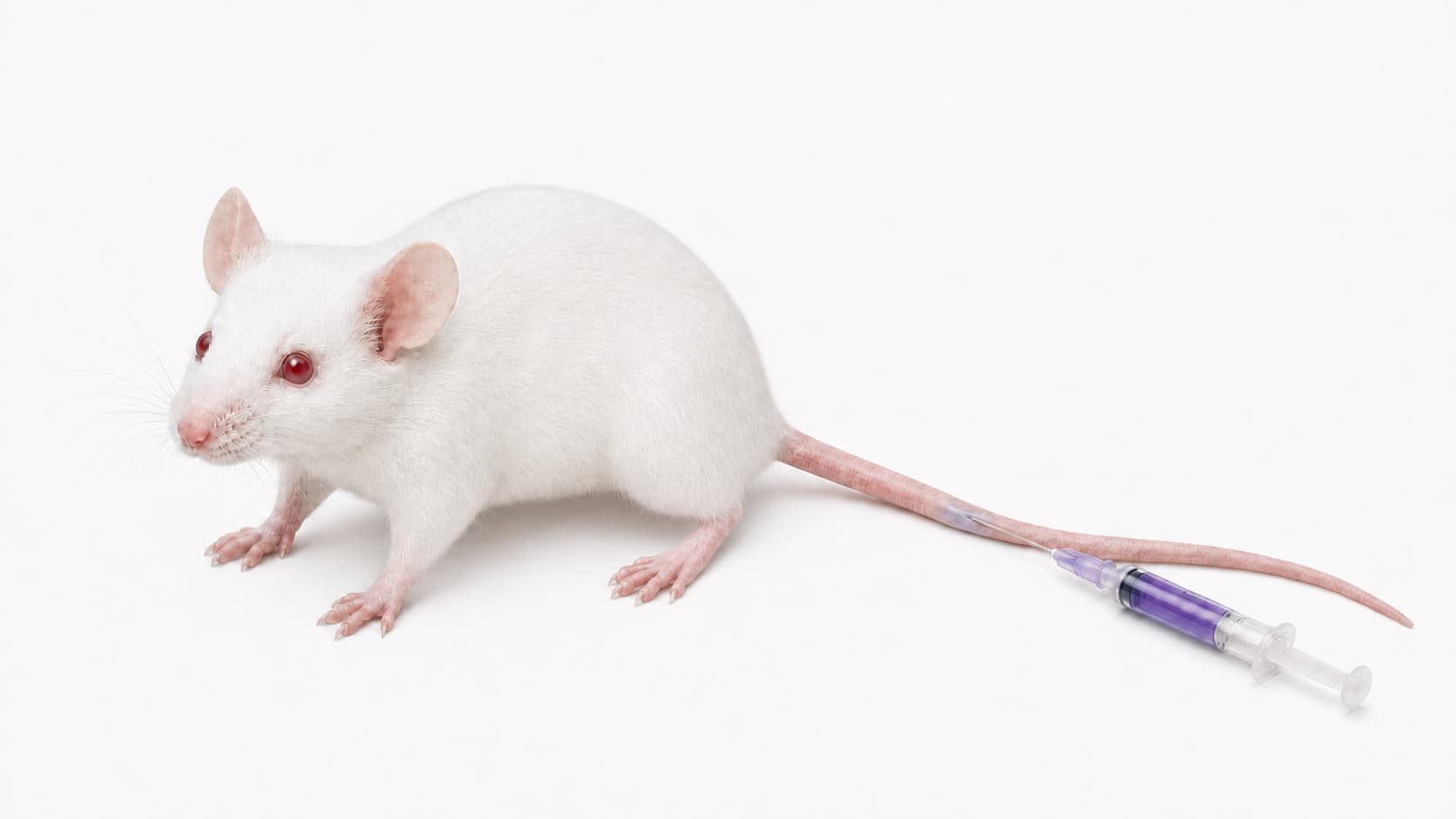
A rendering of a white laboratory mouse on a white ground; a syringe of violet liquid lies along its tail and its fine needle enters the side of the tail
Intravenous dosing: a fine needle in the lateral tail vein

Pharmacokinetics and tissue penetration

Chemical modifications provide high stability in biological fluids, giving AUMsilence sdASO a relatively long half-life in vivo. AUMsilence sdASO can circulate and penetrate tissues such as liver, muscle, tumor xenografts, and even cross leaky areas of the blood-brain barrier at effective concentrations.

For widespread systemic targets, intravenous (IV) injection can be used. For localized action (e.g., knocking down a gene in the CNS), intrathecal injection can introduce the ASO directly into the cerebrospinal fluid. No special formulations or conjugates are needed to achieve tissue uptake, though formulations can be used to further enhance delivery if desired.

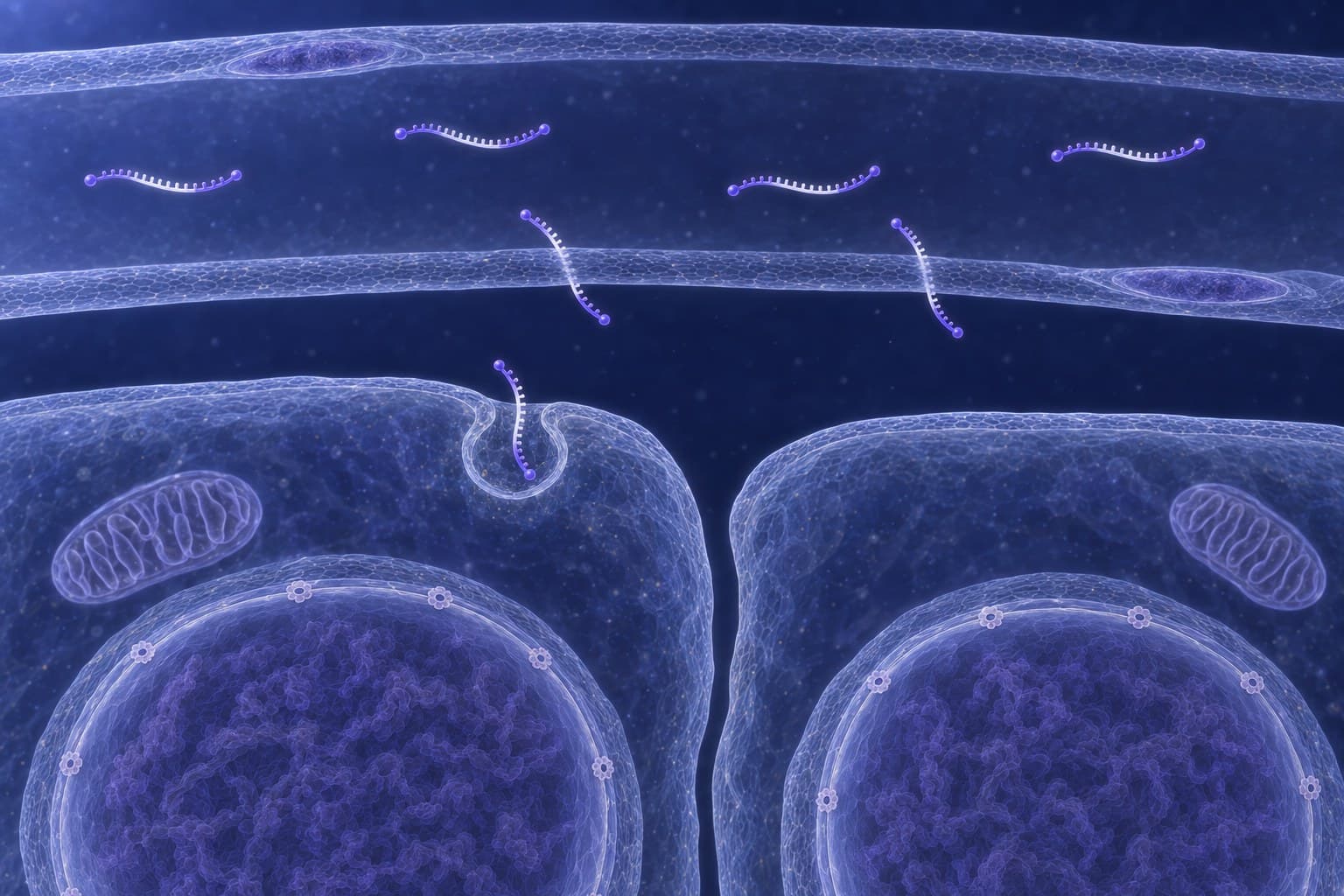
A capillary runs across the top of the frame as a thin translucent tube with two flat nuclei in its wall; in its plasma four antisense gapmers, strands with a pale central gap between two violet wings, drift free, and two more pass down through the lower wall into the tissue beneath, where two cells sit side by side, each with a chromatin-filled nucleus in a pored envelope and a mitochondrion, and the left cell's membrane folds into a pit around one gapmer that is entering it.
Out of a capillary, into the tissue, into a cell

Take your research to the next level

From molecular mechanism to practical execution, we provide a solution that is scientifically rigorous yet streamlined for researchers. AUMsilence sdASO antisense approach stands out for its simplicity, specificity, and adaptability to different experimental systems. Whether you are running a high-throughput cell-based screen or tackling an in vivo disease model, AUM's technology can advance your research goals.

For research use only. Not for use in diagnostic or therapeutic procedures.