

Splice modulation and exon skipping ASOs
AUMsplice
Self-delivering antisense oligonucleotides for splice modulation and exon skipping
AUMsplice
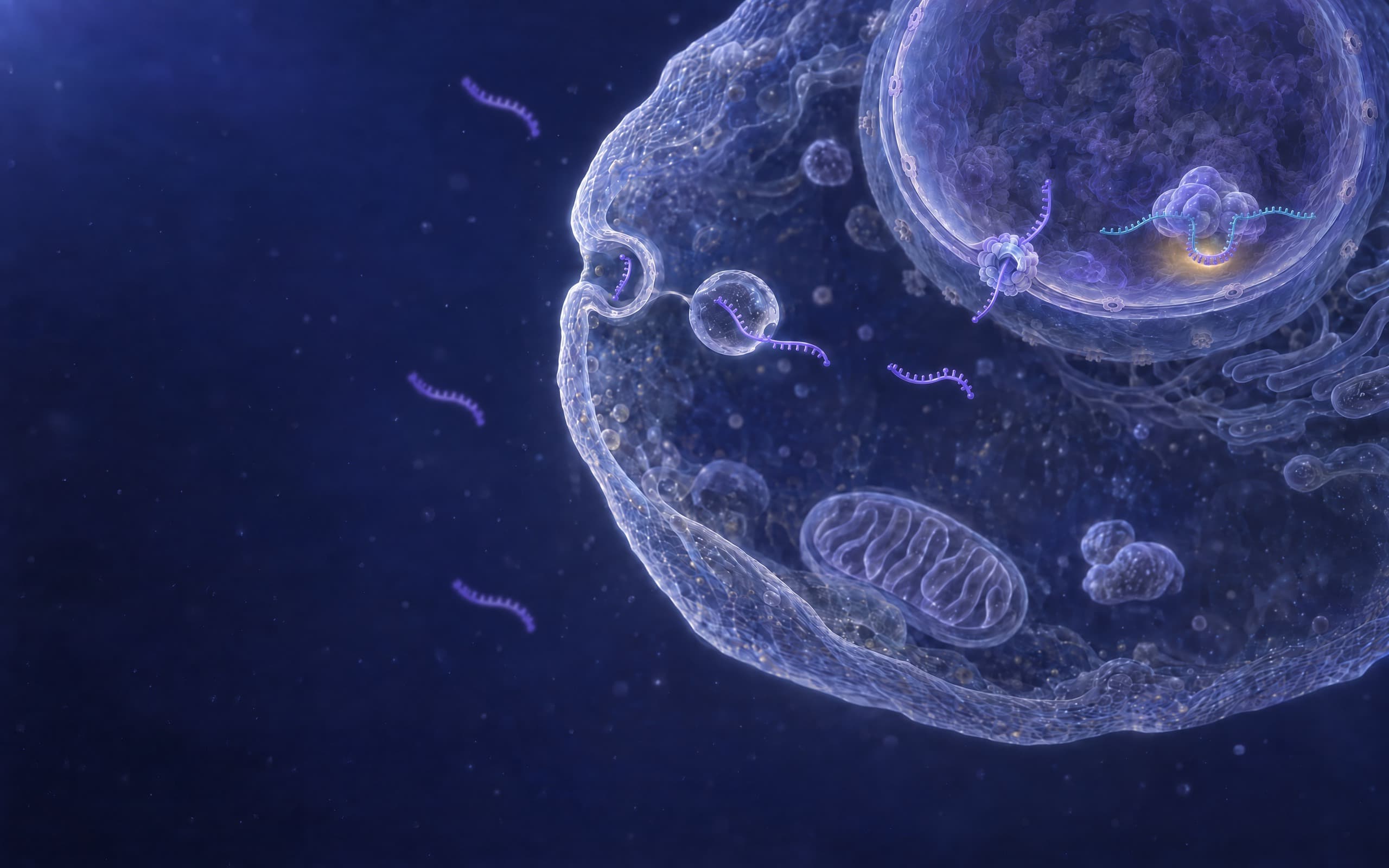
Splicing is redirected in the nucleus, and many of the cells where that is studied are difficult to transfect with conventional methods. Transfection reagents, electroporation, or viral vectors can introduce toxicity, alter the cellular response, or require additional optimization. AUMsplice
- AUMskip
sdASO: the exon-skipping application of AUMsplice sdASO AUMskip
sdASOs are designed to target splice sites or splicing regulatory elements, causing the spliceosome to bypass specific exons during pre-mRNA processing. - Disease-relevant applications
Exon skipping is a proven strategy for addressing certain genetic diseases.
- Self-delivery to the nucleus
AUMsplice
sdASOs are designed to be taken up by endocytosis without transfection reagents and to reach the nucleus, where pre-mRNA splicing occurs. - Sequence design against the target exon
Every AUMsplice
sdASO is designed by AUM against the target the customer names, as part of the price.
Sizes and purification
Available by quote: tell us your target and we design and price it.
Prices and lead time are shown on the order page. Custom sizes by quote.
At a glance
- Class
- Self-delivering antisense (sdASO)
- Targets
- Splice modulation and exon skipping
- Delivery
- Add to culture medium or inject in vivo.
- Fluorescent label
- None
In the lab
The protocol in four steps
The steps below are the AUMsplice
Step 1
Cell preparation
Plate cells in their optimum growth medium at a density appropriate for the cell type. A confluency of 50-70% at the time of treatment is typical.
Step 2
AUMsplice
sdASO stock preparation Prepare AUMsplice
sdASO stock solution by reconstituting lyophilized ASOs at the desired concentration. If you already have a stock solution prepared, skip to Step 3. Step 3
AUMsplice
sdASO delivery to cells Add AUMsplice
sdASO to the cells at the desired final concentration. The recommended working range is 5-20 μM, with a starting concentration of 10 μM. The optimal concentration varies with the target gene, the RNA class (messenger RNA, microRNA or long non-coding RNA) and the cell type, and should be determined by titration for each system. Step 4
Incubation and analysis
Incubate cells with AUMsplice
sdASO and analyze splice modulation at appropriate time points.
In vitro, the four steps
Step 1
Prepare cells
Seed the cells in a 24-well plate; the oligonucleotide waits in solution.
Step 2
Add to the medium
Add the self-delivering oligonucleotide straight to the medium: no transfection reagent, no carrier.
Step 3
Incubate
Incubate at 37 degrees C in 5% carbon dioxide, humidified, for the exposure time.
Step 4
Quantify knockdown
Measure the knockdown: RT-qPCR, immunoblot, flow cytometry.
Schematic of the three readouts, not data.
Sources
- The pictures are the object pictures of AUM BioTech's workflow slide, rendered views of the objects on a white ground; none is a photograph of an experiment and none records a measurement.
- Tile 04 is a schematic of the three readouts, not data: the two conditions are drawn with a modest difference to show what each readout is, and no magnitude is asserted.
Why
Features of AUMsplice
AUMskip
sdASO: the exon-skipping application of AUMsplice sdASO AUMskip
sdASOs are designed to target splice sites or splicing regulatory elements, causing the spliceosome to bypass specific exons during pre-mRNA processing. This results in the production of mRNAs lacking those exons, which can translate into truncated but potentially functional proteins. Disease-relevant applications
Exon skipping is a proven strategy for addressing certain genetic diseases. For example, in Duchenne Muscular Dystrophy, skipping mutated exons can restore the reading frame of the dystrophin gene, allowing production of a shortened but partially functional protein. AUMsplice
sdASO enables research in this area. Self-delivery to the nucleus
AUMsplice
sdASOs are designed to be taken up by endocytosis without transfection reagents and to reach the nucleus, where pre-mRNA splicing occurs. They are used to modulate splicing in primary cells, tissues, and in vivo models that are difficult to transfect with conventional methods. Sequence design against the target exon
Every AUMsplice
sdASO is designed by AUM against the target the customer names, as part of the price. Several sequences are designed against different sites in and around the target exon, since which one works best is not predictable in advance. Each is checked for specificity against the transcriptome before synthesis.
Mechanism
Mechanism of action
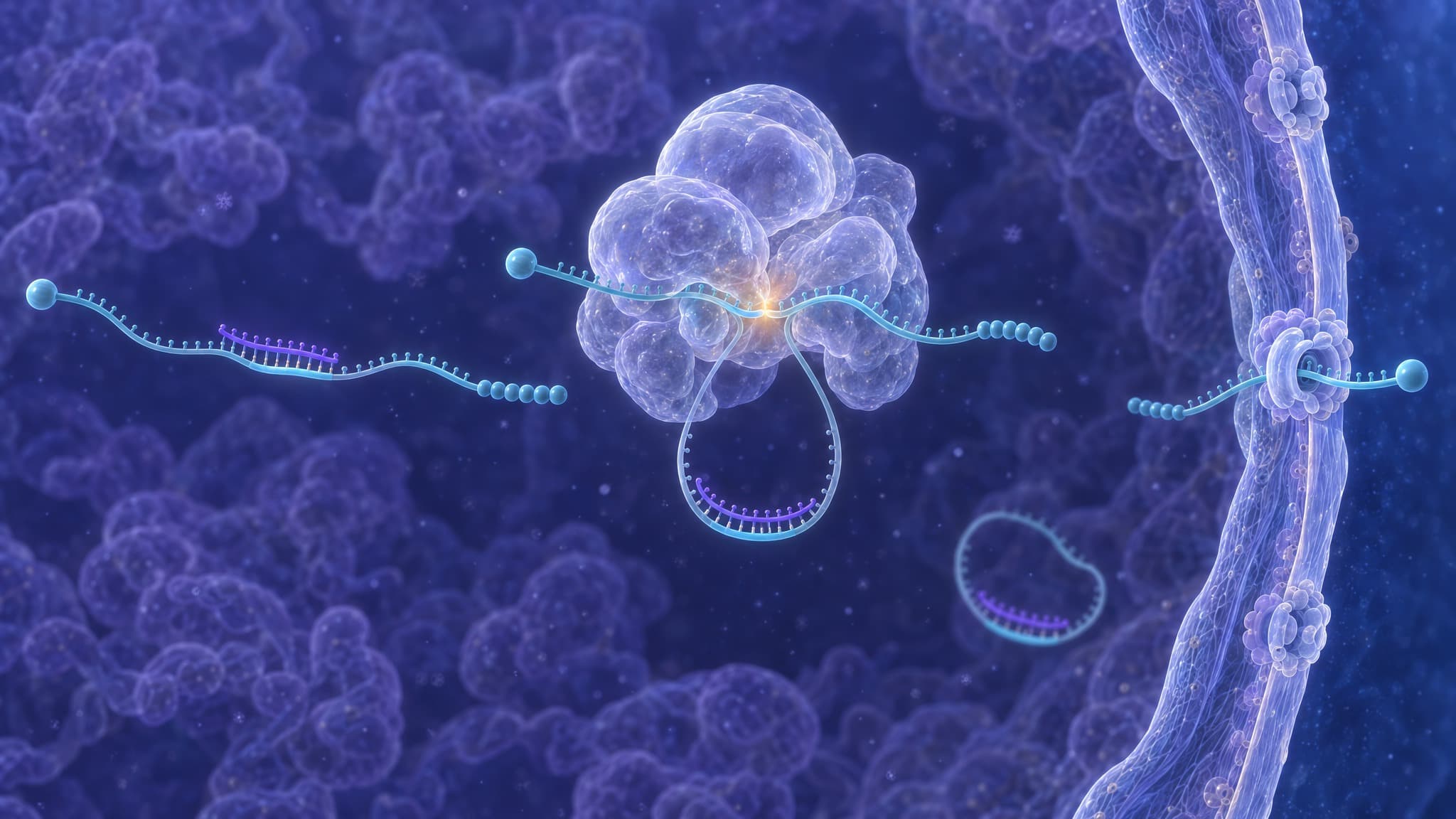
Splice site blocking: After the AUMsplice
Spliceosome redirection: When the spliceosome assembles on the pre-mRNA, the bound AUMsplice
Altered mRNA production: As a consequence, the spliceosome skips over that exon, splicing together the flanking exons (e.g., exon N joined to exon N+2, leaving out exon N+1). The outcome is the production of an mRNA that is missing the targeted exon, resulting in a modified protein product.
- Stage 1
AUMsplice
sdASOs are designed to be taken up by endocytosis without transfection reagents and to reach the nucleus, where pre-mRNA splicing occurs. - Stage 2
After the AUMsplice
sdASO is delivered into the nucleus of a cell, it binds to its pre-mRNA target at or near the exon one intends to skip. - Stage 3
The bound AUMsplice
sdASO sterically hinders the binding of splicing factors that normally recognize the exon's boundaries. As a consequence, the spliceosome skips over that exon, splicing together the flanking exons.
Applications
Applications and use cases
Genetic disease research
AUMsplice
sdASO is used in research on diseases like Duchenne Muscular Dystrophy (DMD), where skipping a mutated exon can restore the dystrophin reading frame. It is also used in research on Spinal Muscular Atrophy (SMA), where the splice-modulation strategy is exon inclusion rather than skipping. AUM designs the sequences against a patient-specific mutation or against a general disease model. Alternative splicing research
If you want to study what an alternatively spliced exon does, use AUMsplice
sdASO to specifically exclude that exon from the mRNA pool. The effect on the cell is then assessed. No knockout model is made, which would require deleting the exon from the genome, and the effect is reversible. Protein engineering
In some cases, skipping an exon can produce a desirable protein isoform. A researcher may intentionally skip an exon that encodes a domain to see how the truncated protein behaves. AUMsplice
sdASO allows generation of such isoforms without genetic engineering. Gene function rescue
Exon skipping can sometimes rescue a gene's function by removing a problematic segment. For instance, if an exon contains a frame-shifting insertion, skipping that exon via AUMsplice
sdASO may restore the downstream reading frame and partially rescue expression.
Every compatible cell type, 3D model, organoid and in vivo route, with the in vitro workflow.
See where it worksExperimental considerations
The working concentration is higher than that of a transfected oligonucleotide. The recommended working range for AUMsplice
AUMsplice
At the bench
Protocol, controls and what arrives
Add to culture medium or inject in vivo. The protocol, the controls and the How much to order page are written for this product.
- Lead time
- 10-14 business days
- Shipping
- Products are shipped lyophilized, with priority shipping within the United States and international priority shipping elsewhere.
- Quality control
- Every oligo is strictly controlled for quality and is manufactured in an ISO 9001:2015 certified facility.
Request a quote for AUMsplice
Provide us with your gene and exon of interest, and AUM designs the sequences for your target. A scientist is available before ordering to discuss the target and the cell type.
For research use only. Not for use in diagnostic or therapeutic procedures.