

Viral RNA knockdown oligos
AUMsilence V+
Self-delivering antisense oligonucleotides for viral RNA knockdown
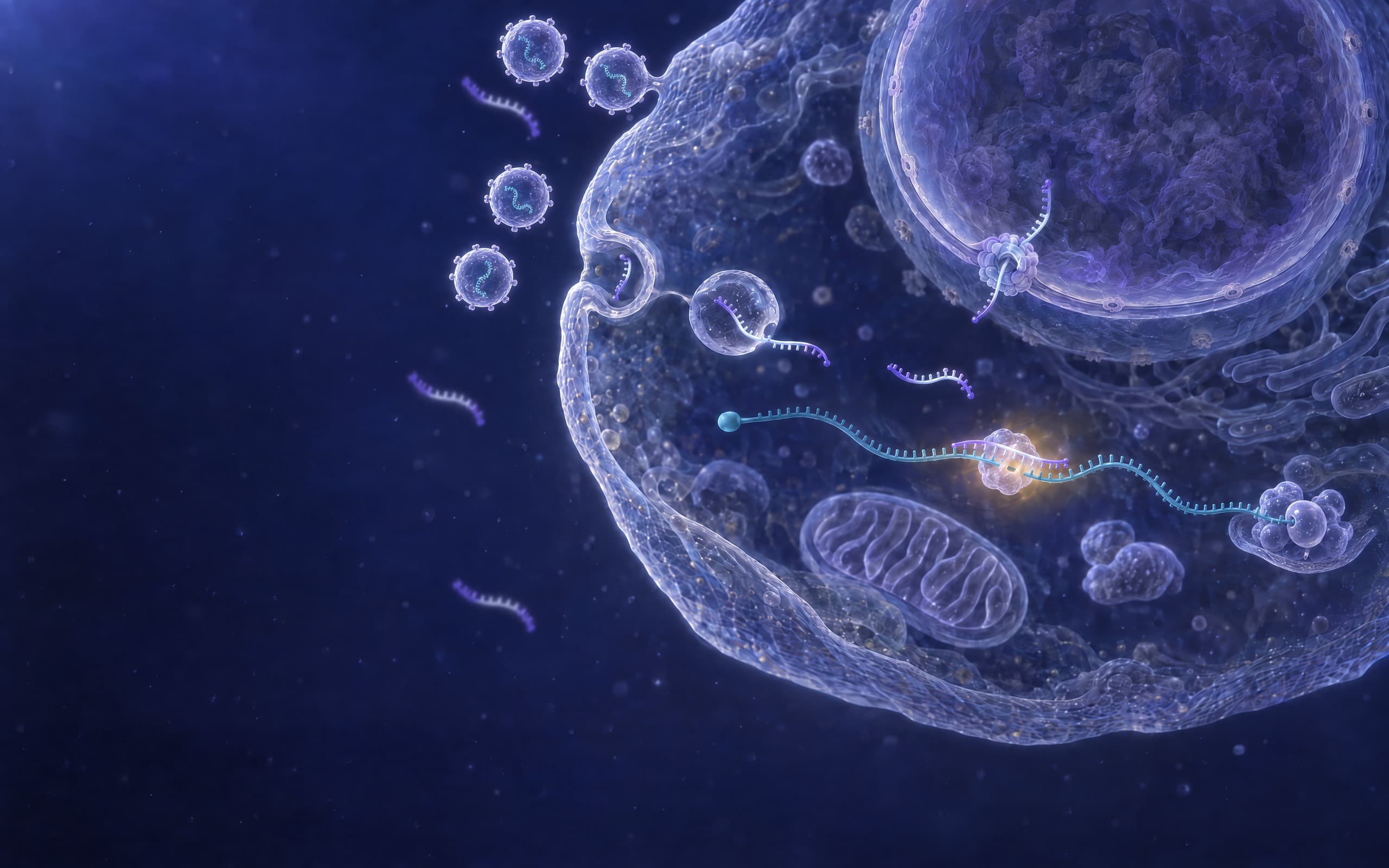
AUMsilence V+
Many viruses infect cells that are difficult to transfect with conventional methods. Transfection reagents, electroporation, or viral vectors can introduce toxicity, alter the cellular response, or require additional optimization. AUMsilence V+
- Viral-specific design
AUMsilence V+
sdASOs are designed for viral targets. - Several viral targets in parallel
AUMsilence V+
sdASOs are designed against several viral targets at a time, so the targets are tested in parallel.
Yields and purification
Available by quote: tell us your target and we design and price it.
Prices and lead time are on the order page. Custom yields by quote.
At a glance
- Class
- Self-delivering antisense (sdASO)
- Targets
- Viral RNA knockdown
- Delivery
- Add to culture medium or inject in vivo.
- Fluorescent label
- None
In the lab
The protocol in four steps
The steps below are the AUMsilence V+
Step 1
Cell preparation and viral infection
Plate cells in their optimum growth medium at appropriate density for the cell type and viral system.
Step 2
AUMsilence V+
sdASO stock preparation Prepare AUMsilence V+
sdASO stock solution by reconstituting lyophilized ASOs at the desired concentration. If you already have a stock solution prepared, skip to Step 3. Step 3
AUMsilence V+
sdASO delivery to cells Add AUMsilence V+
sdASO to the cells at the desired final concentration. The recommended working range is 5-20 μM, with a starting concentration of 10 μM. The optimal concentration varies with the target gene, the RNA class (messenger RNA, microRNA or long non-coding RNA) and the cell type, and should be determined by titration for each system. Step 4
Incubation and analysis
Incubate cells with AUMsilence V+
sdASO and analyze viral inhibition at appropriate time points.
In vitro, the four steps
Step 1
Prepare cells
Seed the cells in a 24-well plate; the oligonucleotide waits in solution.
Step 2
Add to the medium
Add the self-delivering oligonucleotide straight to the medium: no transfection reagent, no carrier.
Step 3
Incubate
Incubate at 37 degrees C in 5% carbon dioxide, humidified, for the exposure time.
Step 4
Quantify knockdown
Measure the knockdown: RT-qPCR, immunoblot, flow cytometry.
Schematic of the three readouts, not data.
Notes
- The pictures are the object pictures of AUM BioTech's workflow slide, rendered views of the objects on a white ground. None is a photograph of an experiment and none records a measurement.
- Tile 04 is a schematic of the three readouts, not data. The two conditions are drawn with a modest difference to show what each readout is, and no magnitude is asserted.
Why
Features of AUMsilence V+
Viral-specific design
AUMsilence V+
sdASOs are designed for viral targets. Each sequence is designed against regions of the viral RNA that are highly conserved across strains and essential for viral function. Unlike conventional antiviral compounds that target proteins, these ASOs act on the viral RNA itself. Several viral targets in parallel
AUMsilence V+
sdASOs are designed against several viral targets at a time, so the targets are tested in parallel. Silencing each can pinpoint the viral genes that are essential to replication or pathogenesis, which is what antiviral drug discovery needs.
Mechanism
Mechanism of action
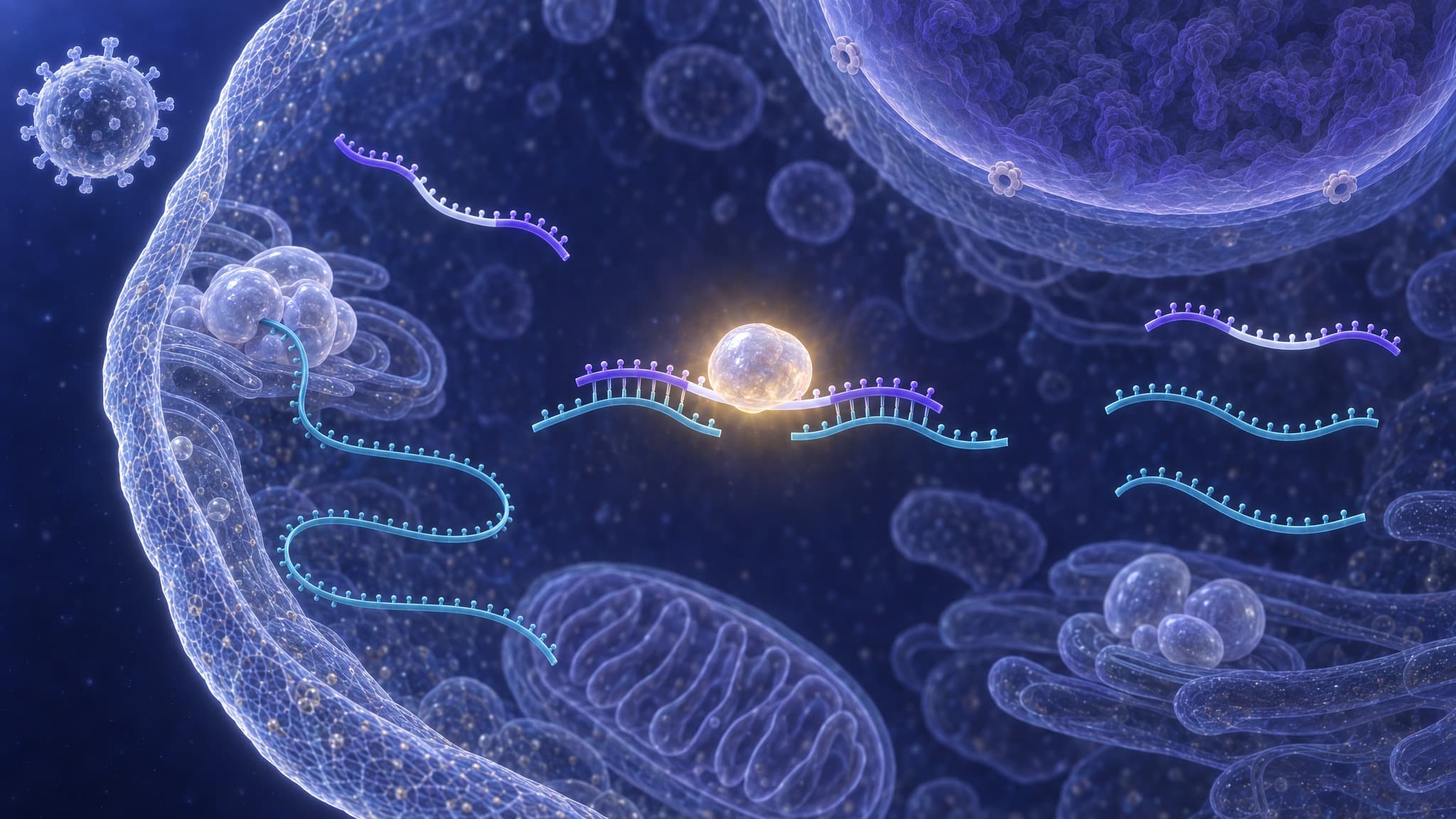
Self-delivery in infected cells: AUMsilence V+
RNase H1-mediated cleavage: AUMsilence V+
- Stage 1
AUMsilence V+
sdASOs are taken up by endocytosis in infected cells, without the need for transfection reagents or special formulations. - Stage 2
AUMsilence V+
sdASOs hybridize to the viral RNA. RNase H1 recognizes the resulting duplex and cleaves the viral RNA.
Applications
Applications and use cases
Inhibition of viral replication
Directly target the viral RNA to prevent replication. For example, targeting the polymerase or protease genes of an RNA virus can halt replication in infected cells.
Viral gene function studies
Systematically knock down individual viral genes to understand their roles in the viral life cycle, host interaction, or pathogenesis. This can identify the viral components that are critical for infection.
Validation of antiviral targets
Before developing small-molecule drugs or another agent against a viral target, use AUMsilence V+
sdASO to validate that silencing the specific viral component prevents viral replication or spread. Research on emerging viruses
When new viral threats emerge, AUMsilence V+
sdASOs are designed from the viral sequence, so viral mechanisms and intervention strategies are studied even before conventional antiviral compounds are available.
Every compatible cell type, 3D model, organoid and in vivo route, with the in vitro workflow.
See where it worksExperimental considerations
The recommended working range for AUMsilence V+
In the literature
AUMsilence V+
Takahashi et al. · Molecular Therapy Nucleic Acids · 2019
Dual Mechanisms of Action of Self-Delivering, Anti-HIV-1 FANA Oligonucleotides as a Potential New Approach to HIV Therapy
AUM co-authored work in which self-delivering AUMsilence sdASOs entered 82.9% of primary human blood cells with no delivery agent and reduced HIV-1 p24 by 69-95% at 400 nM against untreated cells, where the scrambled control of the same chemistry gave 30%. Suppression was still measurable 13 days after a 3 μM treatment, with no immune activation.
Hensel et al. · Epigenetics and Chromatin · 2018
Episomal HBV persistence within transcribed host nuclear chromatin compartments involves HBx
AUMsilence sdASO added to hepatoma cells at 500 nM with no transfection reagent silenced the hepatitis B X messenger RNA and made the viral episome less stable, with episome levels falling from 48 hours onward.
At the bench
Protocol, controls and what arrives
Add to culture medium or inject in vivo. The protocol, the controls and the How much to order page are written for this product.
- Lead time
- 10-14 business days
- Shipping
- Products are shipped lyophilized, with priority shipping within the United States and international priority shipping elsewhere.
- Quality control
- Every oligo is strictly controlled for quality and is manufactured in an ISO 9001:2015 certified facility.
Request a quote for AUMsilence V+
Sequences are designed using the AUMsilence platform. Our scientific team is available before ordering to discuss experimental design and controls.
For research use only. Not for use in diagnostic or therapeutic procedures.