

Blocker oligos
AUMblock
Self-delivering antisense oligonucleotides for steric blocking of RNA function
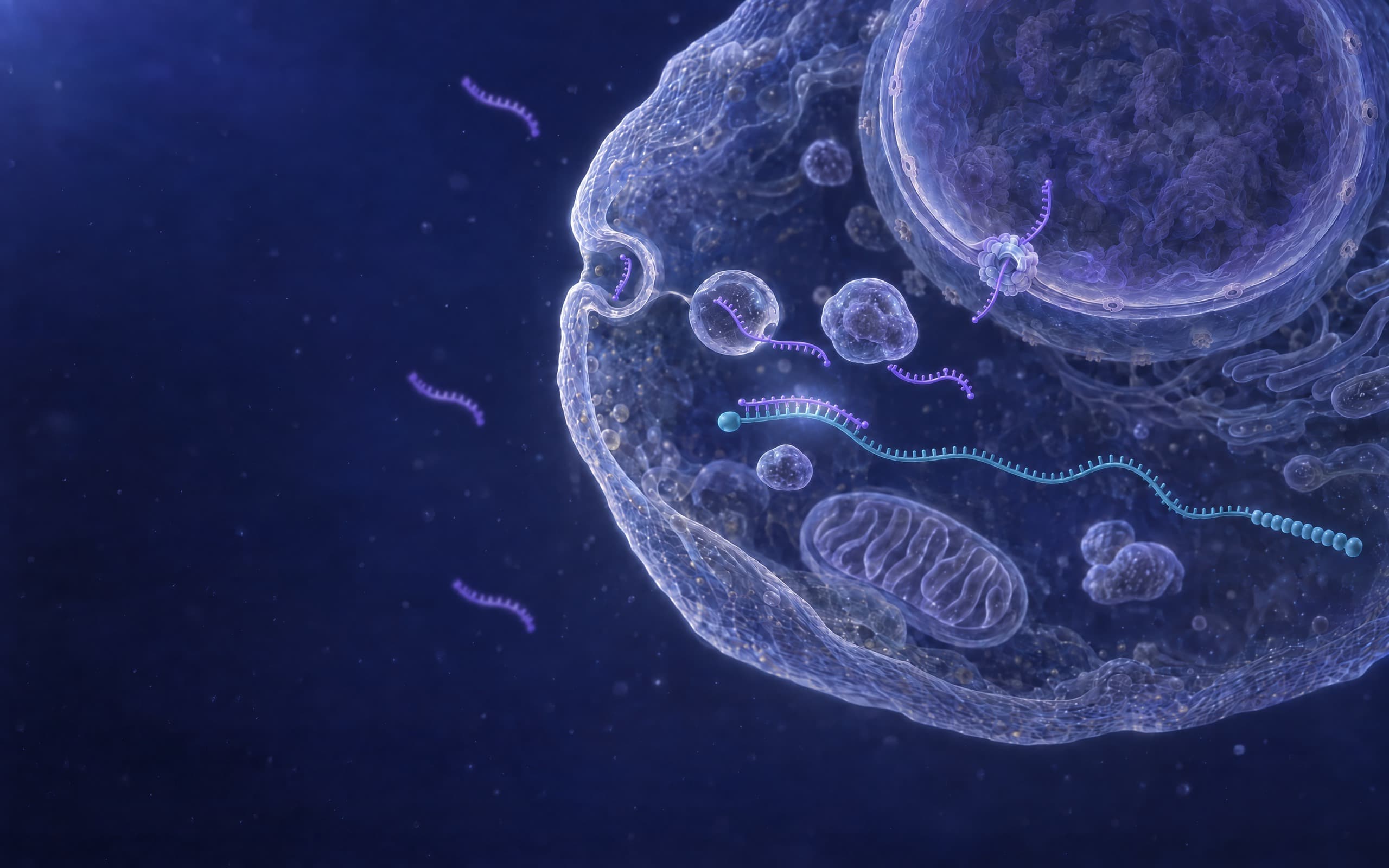
AUMblock
Many primary cells and disease-relevant models are difficult to transfect with conventional methods. Transfection reagents, electroporation, or viral vectors can introduce toxicity, alter the cellular response, or require additional optimization. Like other AUM products, AUMblock
- Steric blocking mechanism
AUMblock
sdASOs bind to their target RNA sequence and physically obstruct the normal binding of cellular machinery, thereby altering RNA function. - Reversible RNA modulation
Because AUMblock
sdASO recruits no RNase H to the RNA, the effect is typically reversible – if the ASO dissociates or is metabolized, the RNA can resume normal function. - Self-delivery capability
AUMblock
sdASOs possess the same self-delivering properties as our other sdASO products. - Sequence design and specificity
Every AUMblock
sdASO is designed by AUM against the target the customer names.
Yields and purification
Available by quote: tell us your target and we design and price it.
Prices and lead time are shown on the order page. Custom yields by quote.
At a glance
- Class
- Self-delivering antisense (sdASO)
- Targets
- Steric blocking
- Delivery
- Add to culture medium or inject in vivo.
- Fluorescent label
- None
In the lab
The protocol in four steps
The steps below are the AUMblock
Step 1
Cell preparation
Plate cells in their optimum growth medium at a density appropriate for the cell type. A confluency of 50-70% at the time of treatment is typical.
Step 2
AUMblock
sdASO stock preparation Prepare AUMblock
sdASO stock solution by reconstituting lyophilized ASOs at the desired concentration. If you already have a stock solution prepared, skip to Step 3. Step 3
AUMblock
sdASO delivery to cells Add AUMblock
sdASO to the cells at the desired final concentration. The recommended working range is 5-20 μM, with a starting concentration of 10 μM. The optimal concentration varies with the target gene, the RNA class (messenger RNA, microRNA or long non-coding RNA) and the cell type, and should be determined by titration for each system. Step 4
Incubation and analysis
Incubate cells with AUMblock
sdASO and analyze the effect on RNA function at appropriate time points.
In vitro, the four steps
Step 1
Prepare cells
Seed the cells in a 24-well plate; the oligonucleotide waits in solution.
Step 2
Add to the medium
Add the self-delivering oligonucleotide straight to the medium: no transfection reagent, no carrier.
Step 3
Incubate
Incubate at 37 degrees C in 5% carbon dioxide, humidified, for the exposure time.
Step 4
Quantify knockdown
Measure the knockdown: RT-qPCR, immunoblot, flow cytometry.
Schematic of the three readouts, not data.
Sources
- The pictures are the object pictures of AUM BioTech's workflow slide, rendered views of the objects on a white ground; none is a photograph of an experiment and none records a measurement.
- Tile 04 is a schematic of the three readouts, not data: the two conditions are drawn with a modest difference to show what each readout is, and no magnitude is asserted.
Why
Features of AUMblock
Steric blocking mechanism
AUMblock
sdASOs bind to their target RNA sequence and physically obstruct the normal binding of cellular machinery, thereby altering RNA function. By design, they do not cleave the RNA target – instead, they exert their effects by getting in the way (steric hindrance). This allows for modulation of RNA function without RNase H mediated cleavage. Reversible RNA modulation
Because AUMblock
sdASO recruits no RNase H to the RNA, the effect is typically reversible – if the ASO dissociates or is metabolized, the RNA can resume normal function. This mechanism provides a tunable way to turn down or redirect gene expression at the RNA level. Self-delivery capability
AUMblock
sdASOs possess the same self-delivering properties as our other sdASO products. They enter cells without transfection reagents due to chemical modifications that enable self-delivery, so cells are treated in one step. Sequence design and specificity
Every AUMblock
sdASO is designed by AUM against the target the customer names. Each sequence is scored for specificity against the transcriptome before synthesis. Off-target effects are sequence-dependent and are checked with a non-targeting control.
Mechanism
Mechanism of action
Translation blocking: If an AUMblock
Splice modulation: If an AUMblock
MicroRNA (miRNA) and long non-coding RNA (lncRNA) interference: AUMblock

- Stage 1
Like other AUM products, AUMblock
sdASOs are engineered for self-delivery into cells without a transfection reagent, electroporation, or a viral vector. No special conjugates or delivery vehicles are needed. - Stage 2
If an AUMblock
sdASO binds in the 5′ untranslated region or across the start codon of an mRNA, it can prevent the ribosome or initiation factors from assembling on that mRNA. - Stage 3
This steric blockade of the translation machinery effectively stalls or prevents protein translation from that mRNA without cleaving it.
Applications
Applications and use cases
mRNA translation inhibition
By blocking ribosome access, AUMblock
sdASO can suppress the production of a specific protein. This is useful for studying protein function (temporary loss-of-function experiments) or knockdown of a protein without RNase H mediated cleavage of the mRNA. Splicing modulation
AUMblock
sdASOs can be directed to alter pre-mRNA splicing patterns. This has applications in correcting aberrant splicing or intentionally skipping an exon. For splice modulation and exon skipping, consider our AUMsplice sdASO product. miRNA blocking
AUMblock
sdASO can function as a miRNA target protector. By binding to the miRNA's target sequence on a given mRNA, it protects that mRNA from miRNA-mediated repression. This approach is useful to validate miRNA–target interactions and to modulate gene expression post-transcriptionally. RNA-protein interaction blocking
Many RNAs have binding sites for proteins. An AUMblock
sdASO can occupy such a motif and act as a decoy, preventing the protein from binding. Assess the functional importance of that interaction by blocking the motif in cells.
Every compatible cell type, 3D model, organoid and in vivo route, with the in vitro workflow.
See where it worksExperimental considerations
The working concentration is higher than that of a transfected oligonucleotide. The recommended working range for AUMblock
Unlike RNA degradation, steric blocking effects should be assessed by functional readouts rather than RNA levels. The readout is the protein, the splice isoform or the interaction the block is aimed at.
In the literature
AUMblock
Shah et al. · Cell Reports · 2025
LncRNA SLNCR phenocopies the E2F1 DNA binding site to promote melanoma progression
An AUMblock sdASO that occupies E2F1 halved melanoma invasion and proliferation, and cells treated before injection then extravasated less into the lungs of mice, without changing the level of either SLNCR or E2F1.
Schmidt et al. · Cell Reports · 2020
Targeting the Oncogenic Long Non-coding RNA SLNCR1 by Blocking Its Sequence-Specific Binding to the Androgen Receptor
AUMblock sdASOs against the androgen receptor binding motif in the long non-coding RNA SLNCR1, delivered to melanoma cells with no transfection reagent, blocked the interaction and returned invasion to control level while leaving the transcript intact.
Schmidt et al. · Cell Reports · 2019
The lncRNA SLNCR Recruits the Androgen Receptor to EGR1-Bound Genes in Melanoma and Inhibits Expression of Tumor Suppressor p21
AUMblock sdASOs added to the medium of patient derived melanoma cultures, with no transfection reagent, cut proliferation by breaking the SLNCR to androgen receptor interaction while leaving the long non-coding RNA itself intact.
At the bench
Protocol, controls and what arrives
Add to culture medium or inject in vivo. The protocol, the controls and the How much to order page are written for this product.
- Lead time
- 10-14 business days
- Shipping
- Products are shipped lyophilized, with priority shipping within the United States and international priority shipping elsewhere.
- Quality control
- Every oligo is strictly controlled for quality and is manufactured in an ISO 9001:2015 certified facility.
Request a quote for AUMblock
Provide us with your target and the species, and AUM designs the sequences, as part of the price. A scientist is available before ordering to discuss the target and the cell type.
For research use only. Not for use in diagnostic or therapeutic procedures.